
China
Riding a Chinese sleeper train from Shenzhen to Guilin in China
I spent the last week traveling in Southeast China – mainly in the area of Guilin and the surrounding towns Yangshuo and Xingping. It was a wonderful journey, and I documented every second of it. First I wanted to talk about the difference between these sleeper trains and the high speed trains that China is so famous for. Firstly, I would have taken the fast train if I could have. They are much nicer, newer, and of course faster. However, the tickets for these often sell out fast. I could have gotten fast train tickets going there but I actually wanted to do the long ride in order to document what the sleeper trains are like. This is the inside of a soft sleeper (1st class) cabin:
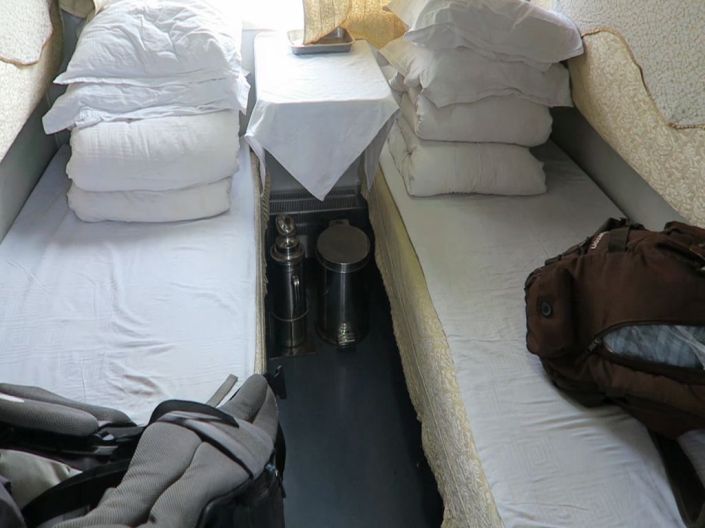
They are relatively comfortable and the bottom bunk costs a bit more than the top. You have fresh blankets and a private space with a door, like a room. The beds are only stacked two high, and not three. There is a table in the middle, and under the table (Not pictured here) there is a power outlet where you can charge your devices, etc. These beds cost about twice as much as the hard sleeper cabins – which are a bit different. They are all stuffed into one cabin (So over 100 beds to a car, and can be very noisy) and the beds are stacked three high. (If you’re on the top, it totally sucks!) The cost of my soft sleeper ticket was 433 RMB which translates to $65 USD. The hard sleeper, comparably, is about half the price. Anyway, as we made our journey outside of the big cities and into the Chinese country side, I got a lot of cool shots!

At around 4:30 PM I began my journey to Guilin from Louhu Station, in Shenzhen. The evening began to come around and darkness began to fall.


And above are some night shots I got as we were exiting Guangzhou. As we made our way into the Chinese countryside, it was really pitch black since there were no cities or towns so I waited until morning to get the rest of my shots. Here they are as we are entering the Guilin area.
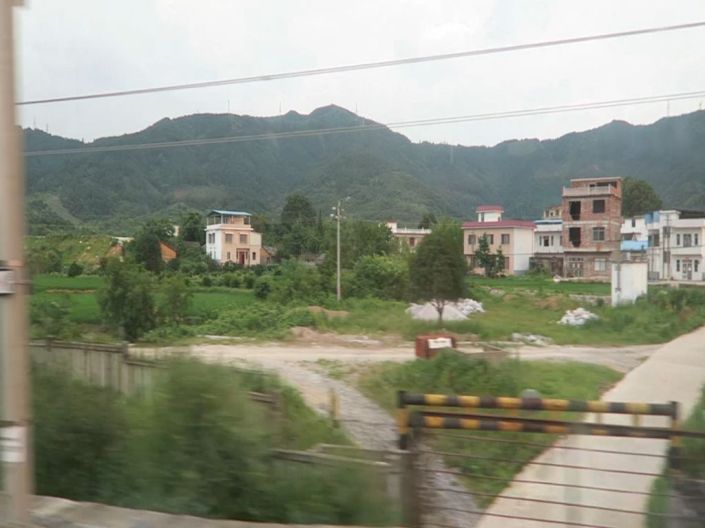
Getting out of the city is something you absolutely must do, even if it’s just once in awhile. The feeling of being out in nature is like nothing else. Guilin is absolutely breathtaking, and I spent a wonderful week there. I will be updating every week with new videos and pics of what we did there. It was a crazy cool adventure! Make sure to check out my YouTube video of the train ride below, and don’t forget to tell me what you think in the comments!


Kung Pao Chicken and Ox Tongue: Spicy Sichuan flavor feast!
Living in China affords access to all of the culinary wonders that is Chinese food. China has many provinces and each one has their own special types of cooking. Sichuan food is renowned for being very spicy and that is just like the meal we had today at a traditional Sichuan restaurant located in the Longgang metropolitan area of Shenzhen. It’s located at the corner of Longping W Road and Aixin Road in Longgang.


It is a very beautiful restaurant There’s even a coy pond with fish swimming around! It’s quite a sight. This is some of the delicious food we had:

The first dish we had is what we know of as Kung Pao Chicken back home, or 宫保鸡丁. This is chicken meat along with peanuts, dried chiles, and leeks fried in a high heat wok covered in a sweet and spicy sauce. This dish is absolute heaven. A lot of Chinese dishes have bones but this is the few that actually use pure chicken meat with no bones. The meat was soft and moist and literally falls apart in your mouth. The leeks give a nice onion essence and the chiles give it some serious heat. This dish is actually one of my favorite Chinese dishes ever, hands down. The next dish we had was a bit different, but still spicy as hell!
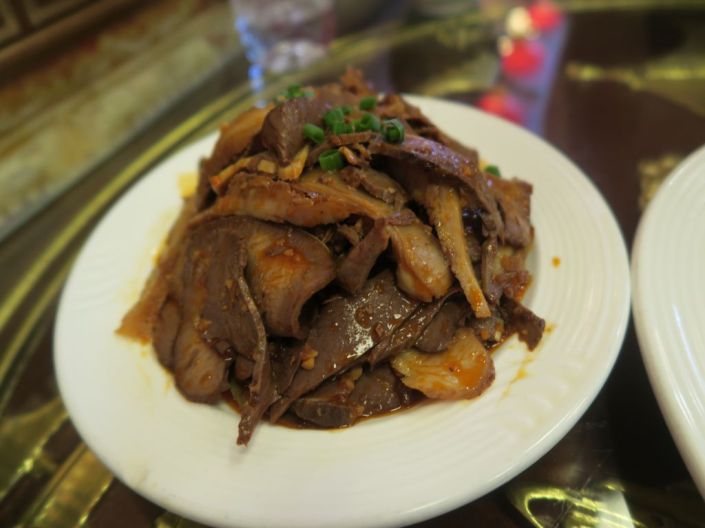
So this dish is called Fu Qi Fei Pian (夫妻肺片) which is sliced beef with ox tongue over a spicy chili sauce. This dish was served cold, but it sure is spicy hot! The tongue is nice and chewy which I really like and reminds me of tripe. It’s covered in a citrus style spicy chili sauce that compliments our other dish very well. Coupling a bite of tongue with the thinly sliced beef is a match made in heaven as you have chewiness mixed with moist tender beef.
So from tomorrow for the next week I will be traveling to Guilin from Shenzhen by sleeper train (It’s about a 13 hour train ride and I will be exploring much of that beautiful area! My blog probably won’t be updated for at least one full week, but when I get back, expect lots of interesting new Asia content! Don’t forget to check out this week’s Sichuan food meal, below:
Enjoying beef hotpot in Huizhou with LaoWhy86
This last weekend I took a trip out to Huizhou – a Tier 2 city in China that is just about a one hour bus ride from Shenzhen. I went there to meet my friend C-Milk, or more commonly known as LaoWhy86 on YouTube. We met at Huizhou’s finest beef hotpot restaurant for some drinks and a meal. The result was some delicious food, crazy Chinese baijiu and good times.
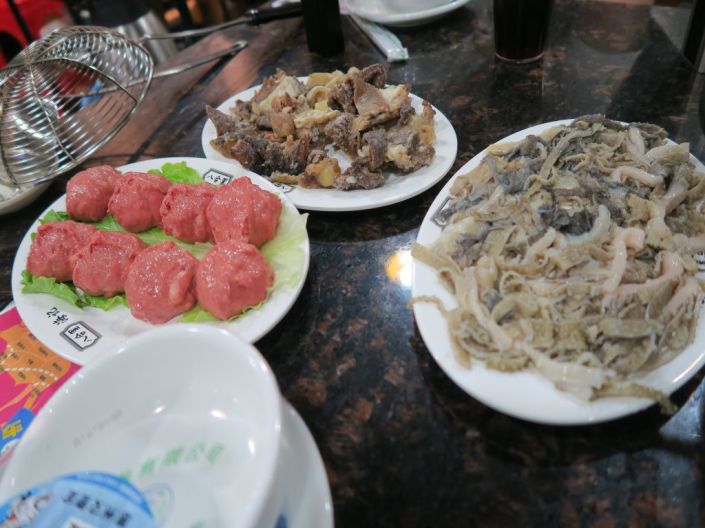
Pictured above are a few of the things that went inside our hotpot. This restaurant is well known for it’s beef and how they make their beef meatballs. Instead of grinding the meat in a grinder, they actually pound the meat for a continuous amount of time without actually cutting it, to make the meatballs. The meat is delicious, juicy, tender, and I found it to be bouncy and different than a western meatball.

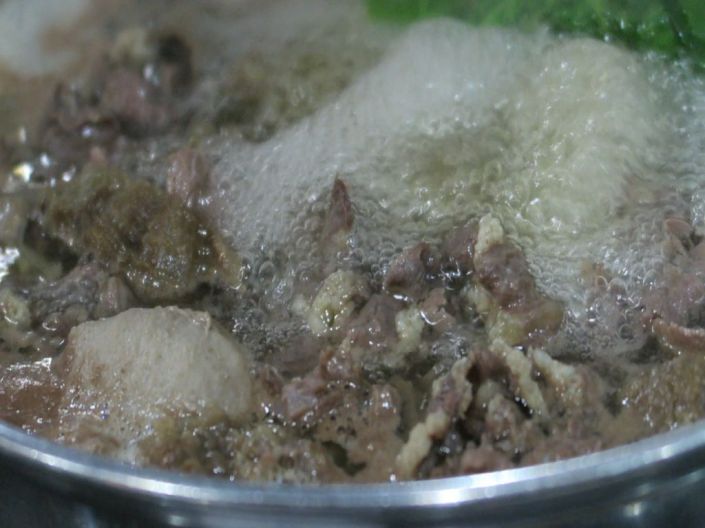
If you aren’t familiar with hotpot (火锅), I’ll fill you in a bit on how it works. There is a large pot of broth in the middle of the table (On top of a hotplate) that is generally filled with spices, vegetables, raw meats, chile peppers, etc and cooked until done. Once it’s done, you just take what you want out of the pot, dip it in your dipping sauce, and you are eating like a king. Hotpot is a little different than other styles of eating because you must cook your food first, but sometimes waiting for it makes it taste even better. Here’s a nice picture of mouth watering beef simmering in our hotpot.
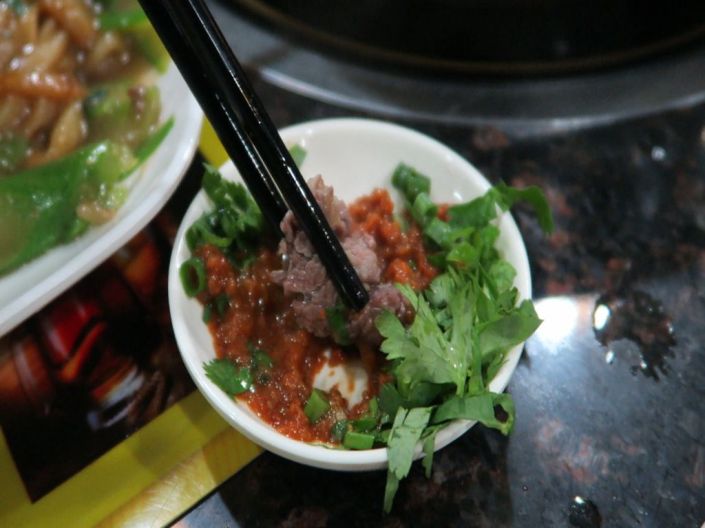
Now the dipping sauce was something out of this world, or so it seemed literally so! When I dipped my first strip of beef into this delicious dipping sauce, I was immediately reminded of a spicy mexican blended salsa. I tasted elements of tomato, cilantro and definitely some chile peppers!
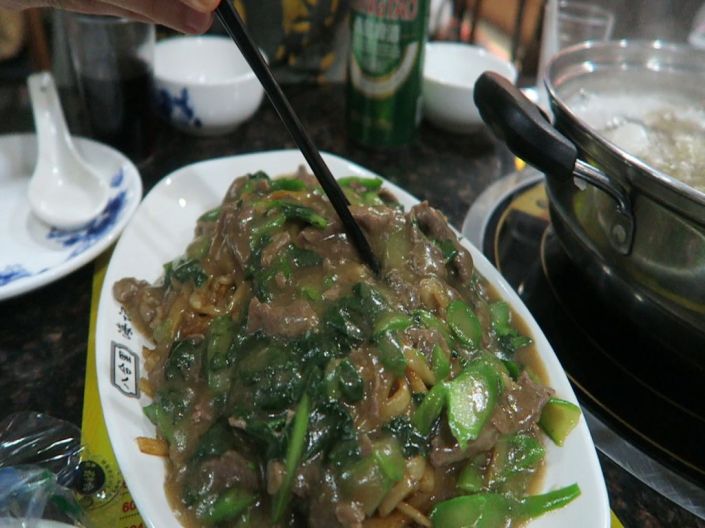
We also ordered some incredibly delicious beef noodles (炒牛肉河粉) that tasted surprisingly creamy. It seemed to be covered in a sauce that reminded me a lot of western gravy, the style that you would put on top of mashed potatoes. It was a little different, but the noodles were sweet and delicious and the beef was nice and tender.
After a few drinks or ten of wine/beer/baijiu, we went back to my friends house for some arm wrestling. It was a good time to say the least!


Make sure to check out my video from this evening – I think you have to see the video to understand the scope of our experience! Don’t forget to check out my channel on YouTube and subscribe if you like the material!
Making ribs and potato salad on the Fourth of July!
Ah, the Fourth of July. The big holiday to celebrate our independence from the British – and I’m in China. Well, though I am far away from home, it is that distance that makes me go so far to learn how to cook! I was craving delicious BBQ ribs and potato salad, which is typical Fourth of July fare. I had never made it before, but I did a little bit of research online, made a few modifications, and came up with a couple delicious recipes! Here is the product of what I spent yesterday afternoon cooking:
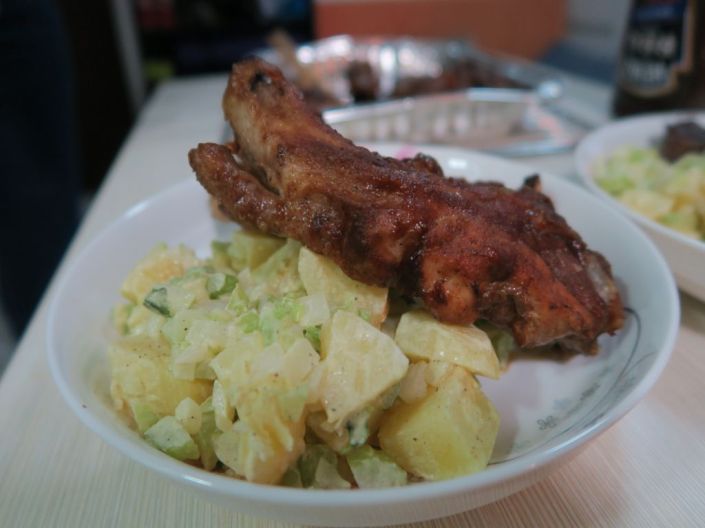
The labor altogether probably took me about three hours, but it was well worth it! Here are what you need to make both the potato salad and the ribs.
Ribs Ingredients:
- 1-1.5 kg of pork ribs
- Bottled BBQ sauce (I used Heinz)
- 1/2 cup brown sugar
- 1 tsp Ground black pepper
- 1 tsp Ground red pepper
- 1 tsp Garlic powder
- 1 tsp Salt
Potato Salad Ingredients:
- 5 medium potatoes, peeled and chopped
- 1 white onion chopped fine
- 1 bunch of celery chopped fine
- 1 big teaspoon of mayonnaise (The more the better usually)
- One big teaspoon of mustard
- Salt to taste
- 1 tsp ground pepper
Let’s get to how you make these delicious dishes! Let’s just start with the potato salad:
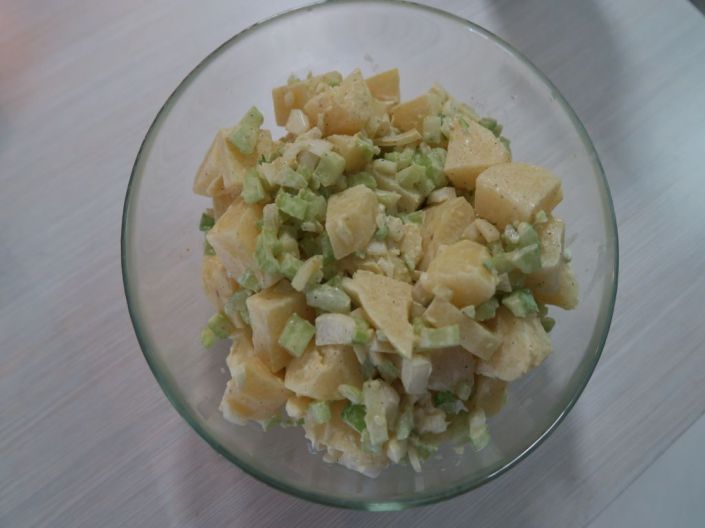
Potato Salad:
To make the potato salad, start by peeling and chopping your potatoes into chunks. Next, boil the potatoes in a pot for 15-17 minutes. Drain into a colander and let cool for a few minutes. In the meantime, chop the white onion and celery fine. Once the potatoes have cooled a bit, combine the potatoes with the chopped celery and onion, the mustard, the mayonnaise, and the salt and pepper. Mix together until the mayonnaise is well distributed. I only used one big teaspoon for my salad because I don’t like excessive mayo – You can even double up on it though if you want it a little creamier. Put it all into a bowl and wrap it in plastic, and put it in the fridge for 30 minutes – 1 hour to chill it. Delicious!
Next, let’s move onto the ribs.
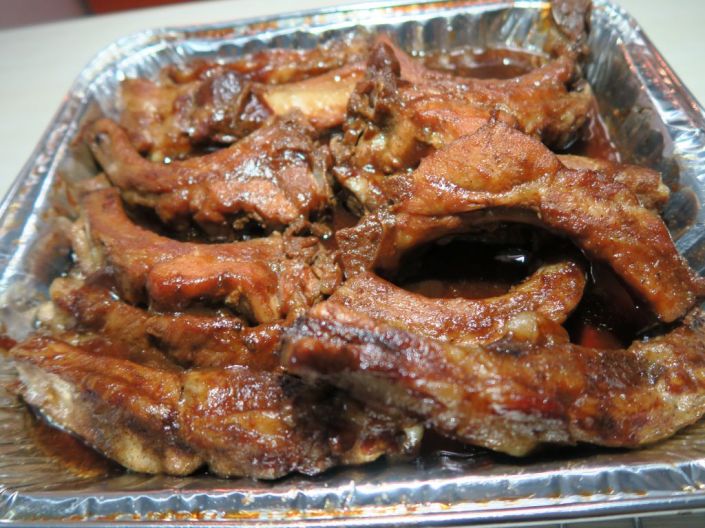
To make these mouthwatering ribs, start by combining the brown sugar with the salt, pepper, red pepper, garlic powder, and the brown sugar in a bowl and mixing it all together. Pour it out onto a tray or some kind of surface and spread it out. Wash and pat dry the ribs with some paper towels. Then start by dipping the ribs into the rub, and be sure to get each rib well coated on both sides with the rub. Cover your cooking tray in aluminum foil. Once all the ribs are coated, pop them into the oven at 150 degrees celsius (300 Fahrenheit) for 2 hours. When they are done, pull them out and remove the foil and then cover them with your bottled barbecue sauce. Brush them with a sauce brush to get them well coated. Place them in the oven for 5 more minutes, remove and brush the other side, and cook for an additional 5 minutes. Then remove the ribs, let them cool for a few minutes and enjoy this delectable Fourth of July treat! Feel free to check out the recipe video for both of these dishes from my YouTube channel below!
Exploring Huaqiangbei, one of the world’s largest electronics markets
Ah, the joys of living in a Tier 1 Chinese city. So many exciting things to see and do. This week I paid a visit to one of the highlights of this glorious city: Huaqiangbei (华强北) is the largest electronics market in China, and one of the biggest on this very earth. Huaqiangbei is home to electronics of every category including computers, smartphones, helicopter drones, RC anything, cameras, you name it! I thought it might be fun to show the world just what this exciting market is like.
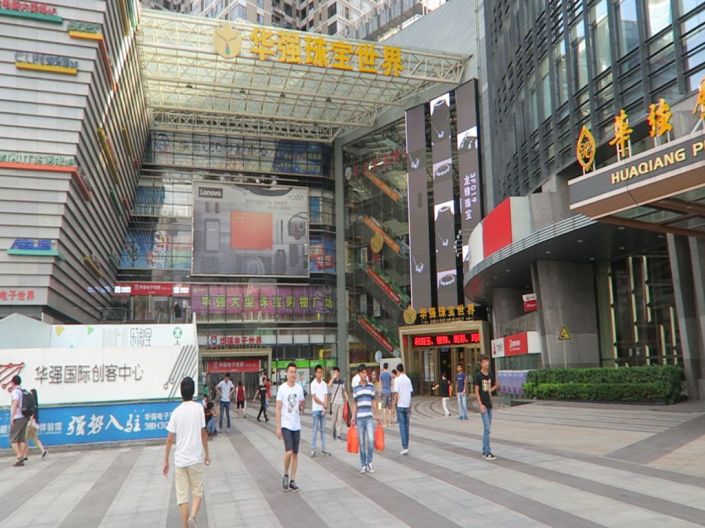
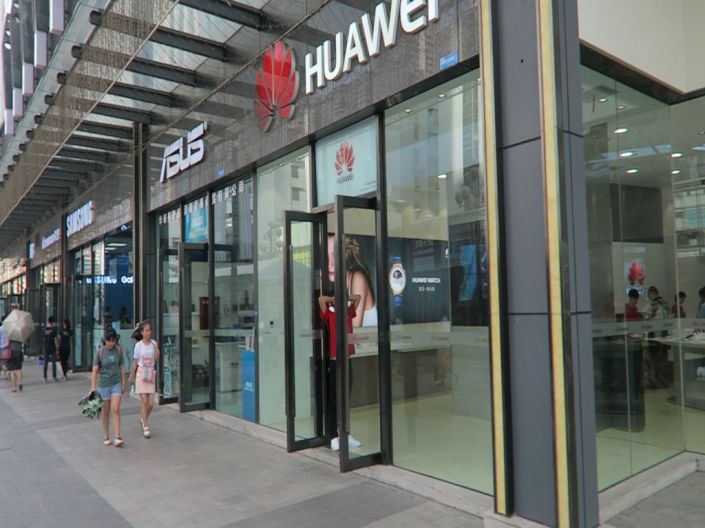
Huaqiangbei has a number of different buildings that have their own markets – some corporate name brands with very recognizable names such as Asus, Dell, Samsung, etc. Other buildings will have few brand names and be full of hundreds of independent resellers pushing products of questionable quality.
There are also plenty of popular Western and Chinese restaurants here. Burger King is here and in fashion. There are a number of pizza places and food courts serving plenty of different cuisines so you’ll find no shortage of delectable eats here also. However, people don’t come here for food. They come here for electronics. And RC products. Lots of RC products.

Now the main and biggest market at Huaqiangbei is located inside the SEG building. This iconic building is insanely tall and has a history of both shady and good deals. Here are a couple pictures from inside the SEG building below. I wanted to give a better tour of this building in the YouTube video (Located below) but security actually gave me problems with filming, so I had to keep it on the down low.


Overall I had an enjoyable little walk around tour of Huaqiangbei – in the past I have bought many things from here including my current camera (My Canon G7x). Some important tips to remember here:
- Question the great deal you’re about to get. There are a lot of fakes so it is important to make sure whatever you are buying is genuine. If you see an iPhone for 400 RMB, it is fake.
- Don’t forget to bargain – never pay the first price that is asked. You can’t do this at corporate stores, but all independent resellers will try to give you the highest price first. Offering half of what they are asking is usually a pretty good strategy.
- Pay especially close attention to independent resellers. Corporate stores are often 100% legitimate, but even corporate stores can be fake! Yes, there have been fake Apple stores, no joke. Copyright infringement is absolutely rampant in China. I knew someone that bought a Xiaomi Hongmi note from an actual Xiaomi store from Huaqiangbei and it was a fake repackaged old Samsung, so be careful!
Check out my video tour of Huaqiangbei below on my YouTube channel!
Eating some late night Chinese Barbecue in Shenzhen
One of the coolest things about China is how vibrant things can be late at night. Of course, it depends what part of the city you’re in but in most parts, there is usually a late night area with street barbecue that runs into the late hours of the night, sometimes as late as 3-5 AM! It was about midnight last night when we developed some strong barbecue cravings, so we decided to head down to one of our local barbecue spots at Dafen here in the city of Shenzhen. Chinese saokao (烧烤, or barbecue) is absolutely delicious, and I intend to show you just how delicious! First, have a peek at some of the things we had to eat that night:
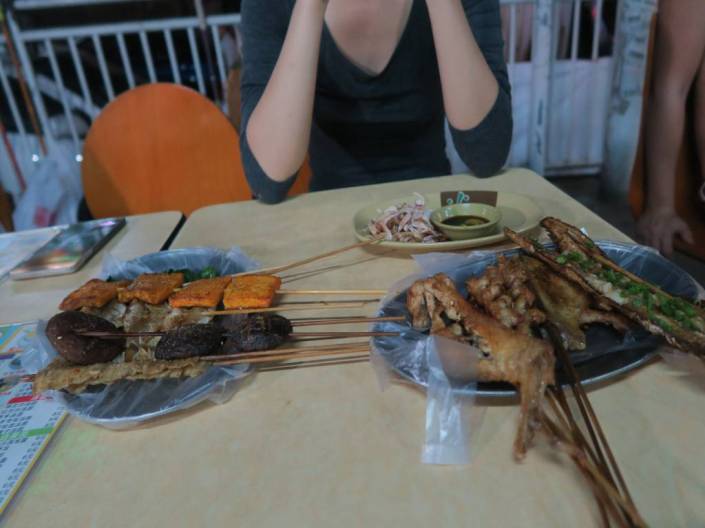
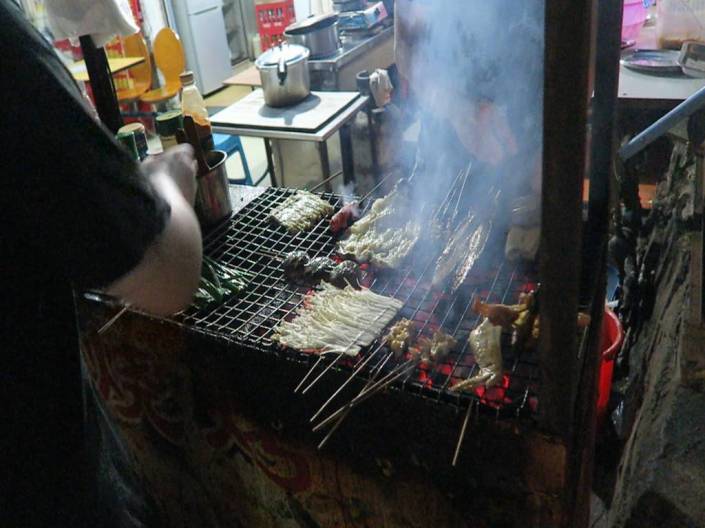
We went to our local barbecue spot (In truth, it was our first time going there since we moved to this new part of town) and checked out what they were offering. We stacked up everything in the basket and gave it to the laoban, and watched them cook it.
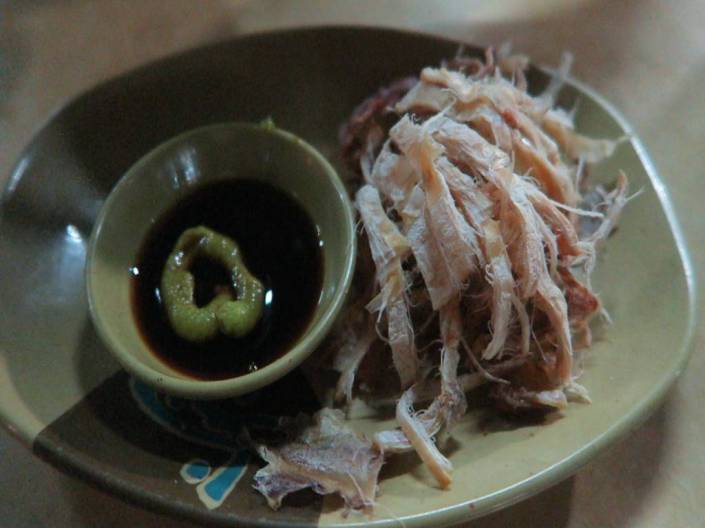
The first thing to sample was an appetizer. We had ordered some dried squid with wasabi and soy sauce, known as youyu (鱿鱼). This had the consistency of something like beef jerky, but with a seafood flavor. When you dip it in the wasabi and soy sauce together, it has a real kick to your nostrils!
The first two things I had tried were the enoki mushrooms (金针菇) and shiitake mushrooms (香菇). I love all shrooms, as they help you to see life clearly! Barbecued mushrooms are no exception, especially when they are topped with special lajiao. After that came tofu (豆腐)that is covered in some kind of spicy orange sauce and also barbecued. Very delicious – much tastier than plain old tofu, that’s for sure! Following the tofu was some spring onions (韭菜) that were delightfully tasty and flavorful. Of course they were covered in oil and barbecued, so they tasted much better than raw!
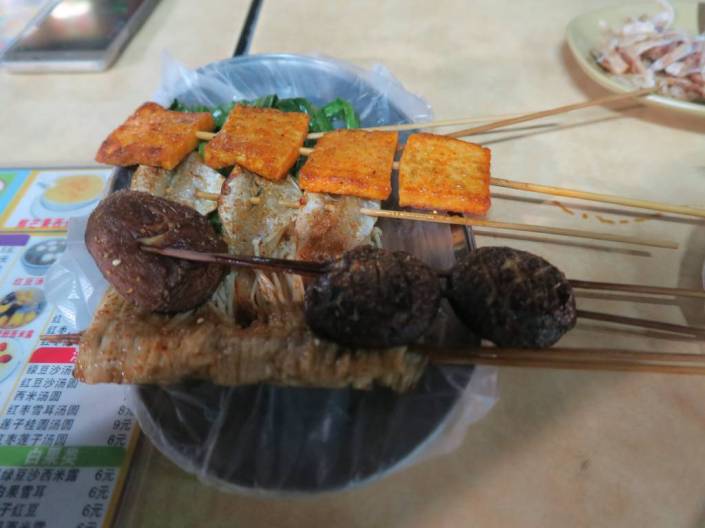
Next up was some koi fish (开心鱼). Now I really had no idea what exactly this skewer was when I saw it. I thought it might be dried shrimp that was barbecued. When we got home and looked it up, I was surprised to find out that it was in fact koi fish.
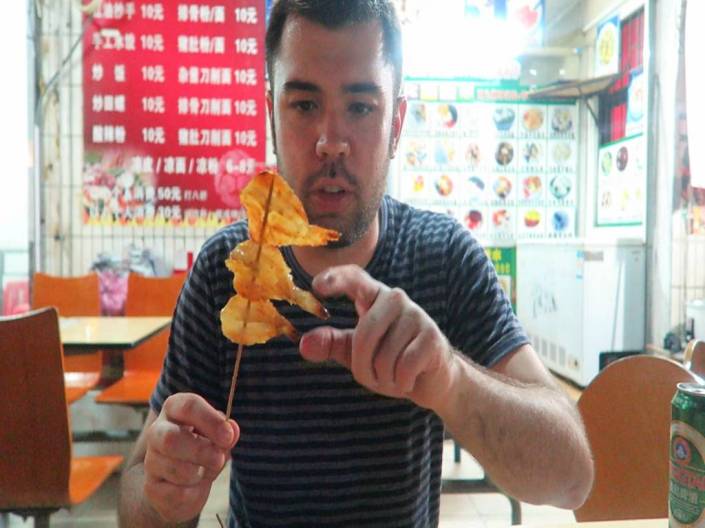
Upon trying this dish, it reminded me a lot more of fish jerky than anything. Overall a nice fishy flavor with that dried chewiness that we so love in jerky.
The last couple dishes were chicken and fish. The chicken (鸡腿) was fantastic. The meat was nice and juicy and tender, some of the skin was crispy, and the lajiao had my mouth on fire at the same time. The fish, which we found out was actually called Ribbonfish (I had thought it was just mackerel) was the best dish of the night, however. The skin was very crispy, the fish meat was pleasant and soft, and the best part is they took out the bones. I rarely eat fish in China because of the strong presence of bones – which I hate! Any Chinese fish dish where the bones are removed is worth 5 stars to me!


Above are the chicken and fish dishes – click the pictures for a bigger view! That was all we ate that night, and my was it good! The total for the bill came out to 62 RMB, or $9.48 USD! What a steal! Check out the video of this Chinese barbecue adventure on my YouTube channel, below! Please subscribe if you enjoy the content! What do you think of Chinese barbecue? Do you enjoy it? Please let me know in the comments!
How to make Honey Mustard Chicken Sandwiches
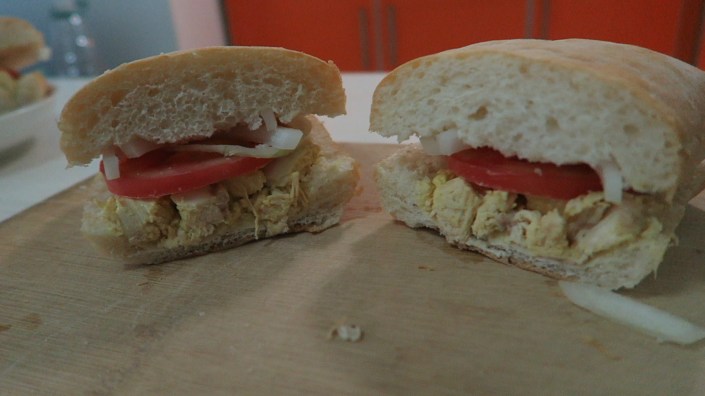
Living in China, Chinese food can get quite boring. That is why I started cooking – before I came to China 2 years ago, I really had no prior knowledge to cooking. After two years of learning, I decided to take my experience to the internet. I like to try and come up with new things all the time, and recently I was really craving some good honey mustard chicken sandwiches. So I came up with a quick and simple recipe using only 7 simple ingredients to make this glorious sandwich you see below:
Ingredients:
- 2 italian bread rolls
- 1-2 tsp mustard
- 1-2 tsp honey
- 1 tbsp mayonnaise
- 1 tomato sliced
- 1 onion sliced
- 2 chicken breasts
To make this sandwich, start by boiling the two chicken breasts in a pot of boiling water for 10 minutes exactly. This will ensure they are not overboiled and are relatively juicy on the inside still. While the chicken is boiling, slice up your tomatoes and onions, and also slice your bread loaves into halves. To make the honey mustard, simply combine the mustard, honey and the mayonnaise into a mixing bowl and stir it until the mixture gets creamy like the honey mustard you are used to seeing.
After the chicken is done boiling, remove the breasts from the pot and slice the breasts into long strips, turning them and slicing them into smaller chunks. When both breasts are cut up into a nice pile of pieces, transfer all the chicken into the bowl with the honey mustard. Stir the chicken together so the honey mustard coats all the chicken pieces nice and evenly.
Now it’s time to make your sandwiches! Using a spoon, spoon out the chicken and honey mustard mixture onto the bread, spreading it out evenly. Cover the chicken with 2 tomato slices and a few sliced onions, and press the sandwich together with the other half of the bread. Cut the sandwich in half for optimal presentation.
I consider this recipe healthier than others because I didn’t use salt, and I didn’t fry the chicken. It’s simply boiled and mixed in with the sauce, and that’s it. I really think you’ll be surprised at how much flavor these sandwiches pack in there – they’re excellent! Check out the recipe on our YouTube video, below!
Eating baozi (包子) and skateboarding in China
This morning I went down the street near the metro station at Dafen to grab some baozi and jump on my skateboard for the first time in a VERY long time. I talked about baozi already before in my first blog post, “What’s for breakfast in China?” but I wanted to take a video for this post, so I thought I would bring them back. Also the first baozi article I did was on beef baozi, and today they were pork!
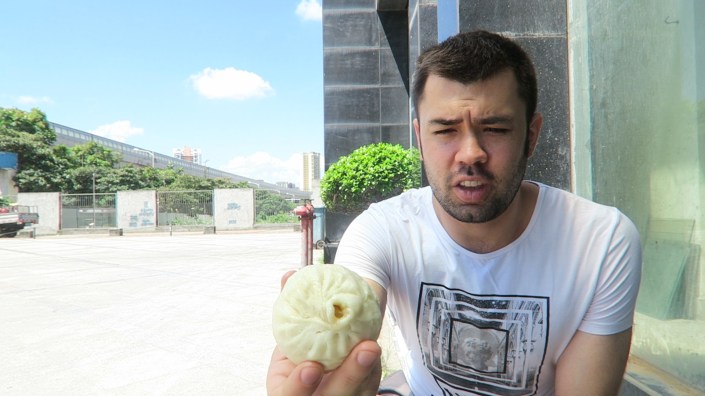
The baozi is a very traditional and one of the most common things that Chinese people eat for breakfast. This particular baozi was full of stuffed pork (Which was fatty and greasy, which is a little heavy for the morning but that’s why you don’t eat too many!) and also some cabbage, if I recall correctly. 1 of these baozi only cost 1 RMB, or $.15 USD so my breakfast only cost $.30 since I had two. That baozi was more than enough fuel to give me the energy I needed to pull off a few skateboarding tricks.
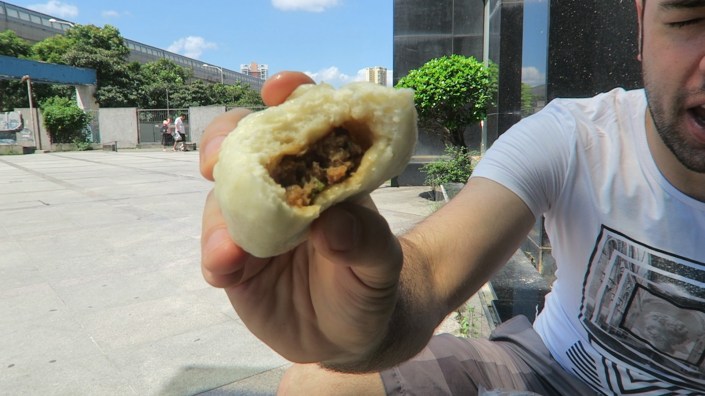
As I proceeded to bite into the delicious baozi, something insane happened. The fatty pork juices dripped out, and nearly landed on my shorts! Luckily I was quick enough to recover, only having to explain to the camera what had happened with my mouth open and simultaneously full of baozi. A baozi stain is no fun – I assure you and I am happy I avoided it. Those juices however, are delicious so I highly recommend taking a more full bite and making sure you get the juice with it! After finishing those delicious baozi, it was time for some skateboarding. I used to skate a lot in my younger years (13-20 years old) but pretty much stopped shortly after high school. However, it’s still fun to roll around and do some tricks sometimes!

An enjoyable morning it was, though hot! By the time I was done skating, I was absolutely drenched in sweat. Nevertheless, please be sure to check out the breakfast video from this morning, which also comes with a little bit of skateboarding attached! What do you think of baozi? Let me know in the comments!
Walking around at Dafen oil painting village
I recently had a chance to visit the Dafen Oil Painting Village (大芬油画村) near my home in Shenzhen. I happen to live very near, just a 5 minutes walk away from one of the most famous spots for artists to hang around in the world. The Dafen Oil Painting Village was founded in the early 90’s by a group of artists. Since then it has become a haven for some incredibly talented artists who churn out amazing replicas and original paintings at incredible prices.
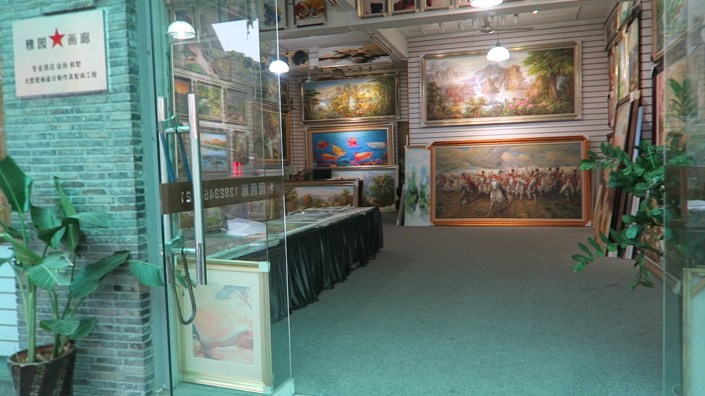
So I thought it was time to take a walk through this village that everyone always talks about. I am not a big fan of art, however I do appreciate it. Although, I am not the kind of person who is going to spend a lot of money on a fine painting. While walking through this painting village, I saw some incredible works of art.


While walking through, I noticed a large number of paintings I had seen before. Notably, Rembrandts, Picassos, and Dali were probably the most common artists I saw replicas from in the entire village. I was hoping to get some cool pictures and footage INSIDE the art shops, but every owner was adamant about not taking photos or video inside their shops. This is because there are many people trying to copy artwork and they are trying to defend their “intellectual” property which I find ironic, since most of the work I saw were replicas anyway.

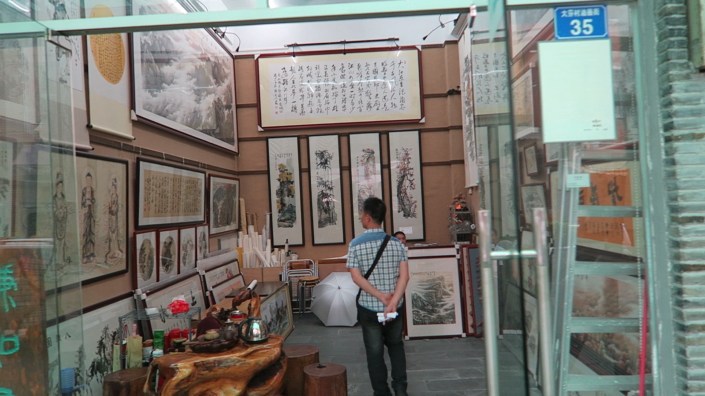
Just to show you the variety of different paintings at Dafen, here are a few more pictures!


Eventually I found a place that was offering very low priced handmade oil paintings for an incredible price: 25 RMB. or $3.80 USD. I did not really intend on buying any art, but for that price, even I can’t pass it up. Here’s the painting I chose:

Overall, I was very happy with my purchase and plan to return to the painting village again sometime, maybe I’ll even up my budget for something a little more grand! Please check out our walk through at the painting village in our YouTube video below:
Chang fen: A Chinese breakfast staple
This morning I returned to my local laoban to do a Chinese food video about breakfast. Today we had chang fen (肠粉) which is a common breakfast dish made with rice paste, eggs, vegetables, and ground pork covered in a pork fat broth with soy sauce and chopped garlic. I probably have chang fen at least once a week living here. I find it to be a relatively healthy option – as this is steamed and not fried, and I enjoy eating as healthy as I can.
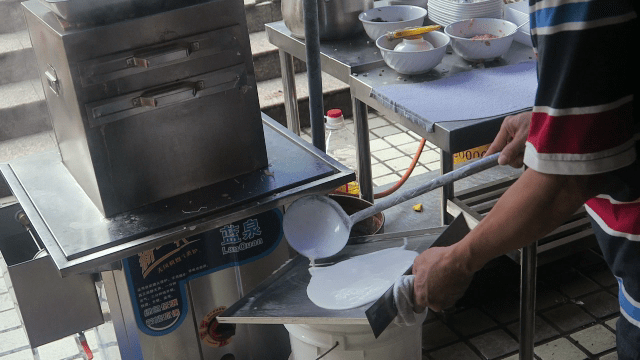
To make chang fen, a large multi-layer steam rack is used. Generally they start by pouring rice paste and covering the tray with it, and then adding ground pork, a few vegetables and cracking an egg or two on top. The mixture is stirred around and sent into the steamer for less than a minute. When it comes out, it is scraped off and set onto a serving plate.
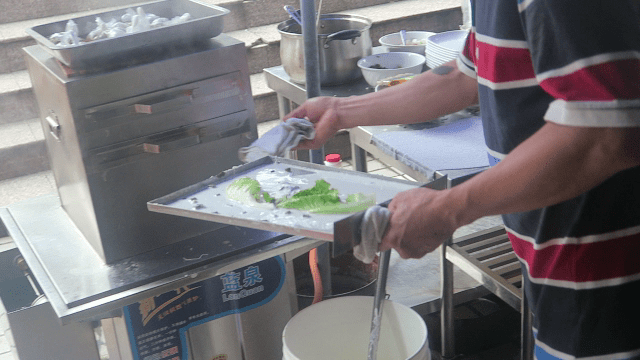
When it comes out, it is quite a pretty sight to behold. The taste of chang fen is interesting to say the least. The texture is sort of a thin jello-ey texture that without the sauce is not exactly bursting with flavor. Rice paste is of course made of white rice, and as we all know white rice has a fairly brand and neutral flavor. However when it is coupled with vegetables, meat, and a nice pork broth with garlic and some chili sauce on top, the flavors go a million ways! The pork broth gives a rich decadent flavor especially when you get those chunks of ground pork in the bite. Grasping some chopped chilis with your chopsticks in a bite adds a spicy aspect to this dish as well.

I also blogged about chang fen back in April, you can see that post here: Chang fen: A cheap, delicious and exotic breakfast in China. Don’t forget to check out the video from this morning’s breakfast which includes video of the cooking process and tasting, from my YouTube channel! Please like/subscribe if you enjoy the content!
- ← Previous
- 1
- 2
- 3
- 4
- Next →
 Ian in China - Living in China content, Asia food and travel videos!