
Chinese
Riding a Chinese sleeper train from Shenzhen to Guilin in China
I spent the last week traveling in Southeast China – mainly in the area of Guilin and the surrounding towns Yangshuo and Xingping. It was a wonderful journey, and I documented every second of it. First I wanted to talk about the difference between these sleeper trains and the high speed trains that China is so famous for. Firstly, I would have taken the fast train if I could have. They are much nicer, newer, and of course faster. However, the tickets for these often sell out fast. I could have gotten fast train tickets going there but I actually wanted to do the long ride in order to document what the sleeper trains are like. This is the inside of a soft sleeper (1st class) cabin:
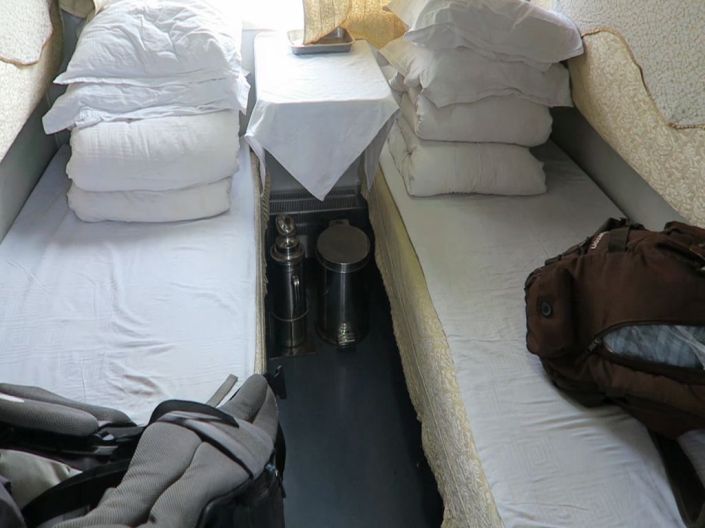
They are relatively comfortable and the bottom bunk costs a bit more than the top. You have fresh blankets and a private space with a door, like a room. The beds are only stacked two high, and not three. There is a table in the middle, and under the table (Not pictured here) there is a power outlet where you can charge your devices, etc. These beds cost about twice as much as the hard sleeper cabins – which are a bit different. They are all stuffed into one cabin (So over 100 beds to a car, and can be very noisy) and the beds are stacked three high. (If you’re on the top, it totally sucks!) The cost of my soft sleeper ticket was 433 RMB which translates to $65 USD. The hard sleeper, comparably, is about half the price. Anyway, as we made our journey outside of the big cities and into the Chinese country side, I got a lot of cool shots!

At around 4:30 PM I began my journey to Guilin from Louhu Station, in Shenzhen. The evening began to come around and darkness began to fall.


And above are some night shots I got as we were exiting Guangzhou. As we made our way into the Chinese countryside, it was really pitch black since there were no cities or towns so I waited until morning to get the rest of my shots. Here they are as we are entering the Guilin area.
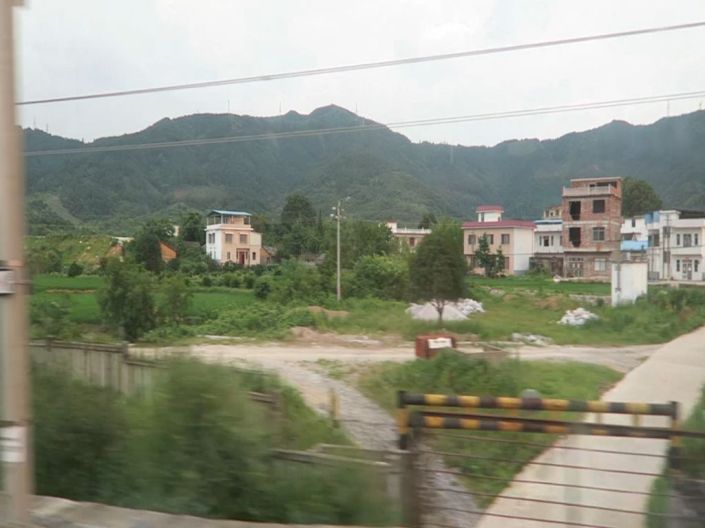
Getting out of the city is something you absolutely must do, even if it’s just once in awhile. The feeling of being out in nature is like nothing else. Guilin is absolutely breathtaking, and I spent a wonderful week there. I will be updating every week with new videos and pics of what we did there. It was a crazy cool adventure! Make sure to check out my YouTube video of the train ride below, and don’t forget to tell me what you think in the comments!


Chaoshao: A sweet and delicious Chinese pork dish.
Today I felt like writing about one of my favorite Chinese foods. The Chinese are celebrating labor day weekend, so traffic in the city is out of control. I’m on the 21st floor but all I can hear are mass numbers of horns honking from the street below.
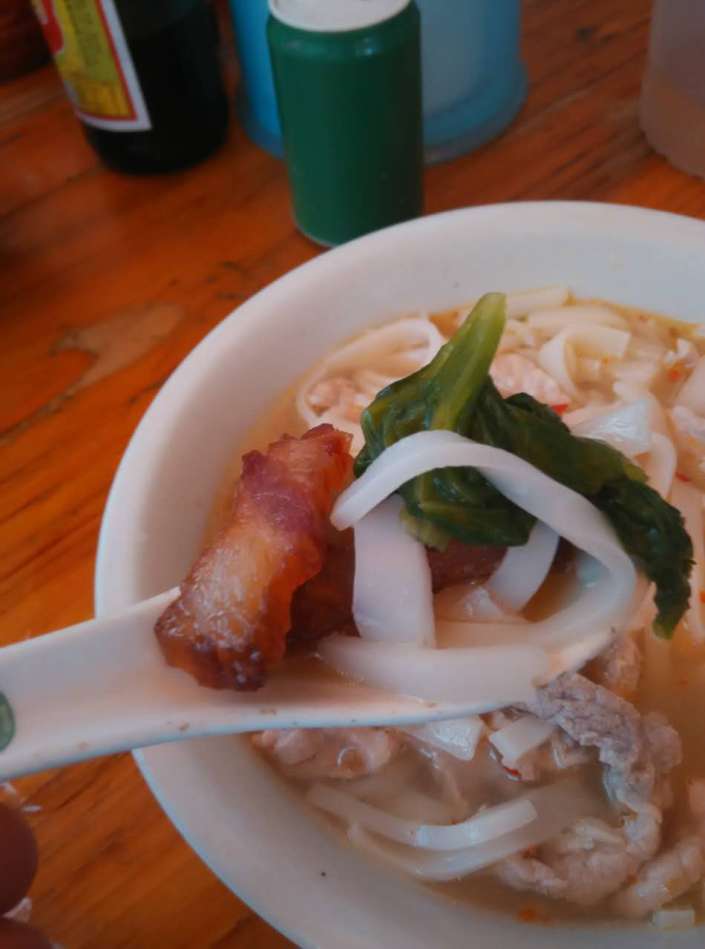
But that won’t stop me from updating the blog! Today we returned to our same laoban from last week, the one that makes killer 猪杂汤粉, pork noodles. We ordered our usual, the noodles, but also ordered a few other things as well. From a separate street stall we ordered 20 RMB worth (~$3.09)of some chaoshao, 叉烧, one of my favorite Chinese pork dishes.
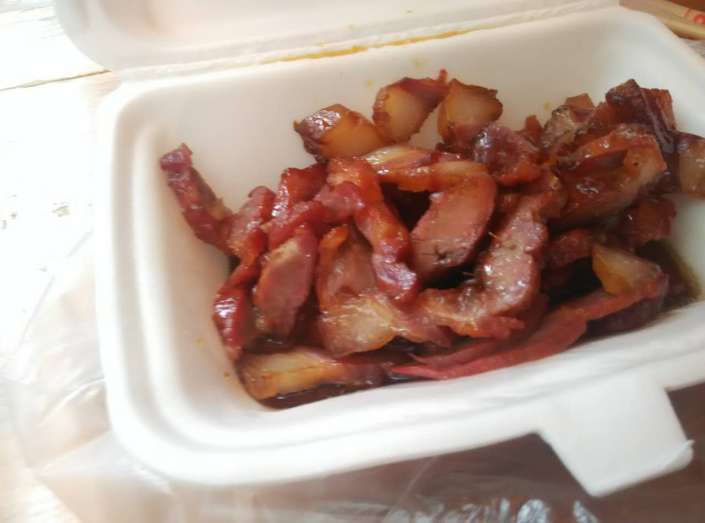
Chaoshao is basically Chinese style roast pork, covered in an incredibly sweet and flavorful sauce. The sauce contains things like soy sauce, spice powder, honey, ginger, garlic, etc. The pork meat is soaked in this marinade for many hours, and then slowly roasted over a cooking fire. Upon tasting this, your flavor receptors immediately go off. It is a great combination of salty and sweet, nice tender meat that isn’t dry. This meat is seriously, OUTSTANDING and I am sure could win awards back home. It’s so good we even combined it with our noodles.
From our noodle laoban we also ordered one other dish: 牛筋丸, or niu jin wan, also known as beef meatballs. The meatballs are 1 rmb each, at a combined cost of 10RMB for all of them (~$1.54)


The meatballs were absolutely outstanding. In China you will often find street vendors selling Chinese soups with vegetables where you can pick the things you want to add from trays (Vegetables, meats, etc) and have the laoban boil them together in a soup for you. Usually the meatballs and fish balls that you will find at these stands are processed factory foods with who knows what in them. I only order meatballs from this particular laoban because I know she does them fresh and from real beef. They were excellent.
When factoring in the cost of our entire meaty and delightful lunch, it only clocked in at 50 RMB, or about ~$7.72.
I’d like to leave you today with Episode 6 from my YouTube cooking show: The Tomato Herbs and Cheese Toasted Sandwich:
Eating duck hearts in South China
So today I thought I’d sample a bit of street food for you all out there. Today I decided to try some ya xin, duck hearts. (鸭心) Your heart may have skipped a beat. Duck hearts? Are you serious man! Are you some kind of vampire or something? No. The truth is, duck hearts a pretty normal part of cuisine here in South China. When I approached the street stall, here were some of the interesting foods before me:
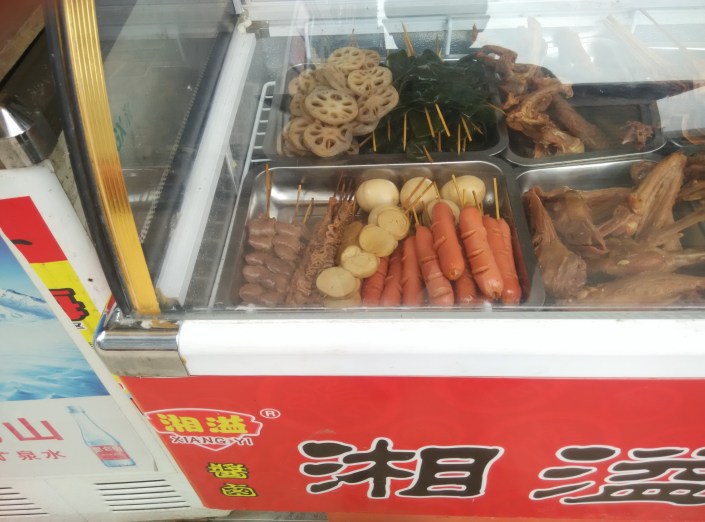
The duck hearsts are in the bottom left corner but if you take a look you can see a couple other interesting things. There are also duck legs, tea eggs, lotus root, and seaweed amongst other things. Not your typical western cuisine to say the least!
Despite what it may sound like though, duck hearts are delicious. They are also very cheap, only 2RMB (~.32 cents USD) per skewer. However, though cheap, they are not exactly pleasing to the eye!
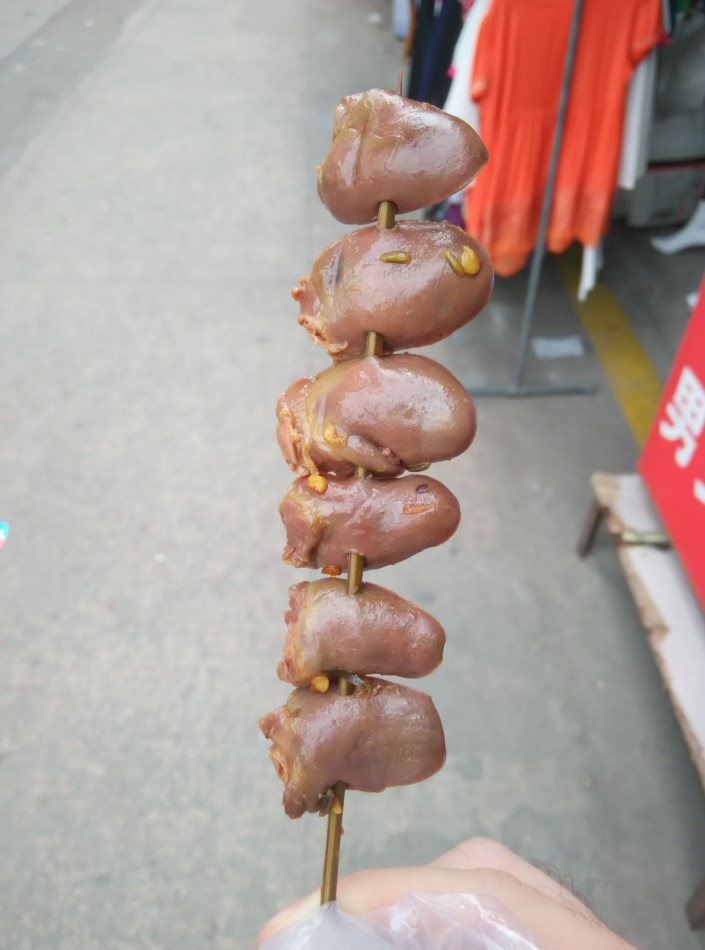
Upon eating this skewer of duck hearts, I have a few comments. Number one, yes they are actually very tasty. However the idea that you are eating the “heart” of something is a little bit disturbing and is kind of hard to get your head around. Once you bite into it you are thinking “Hey, not bad!” but your mind is also thinking..”I’m eating the f**king heart of something..” so your body is not exactly sure how to react. Anyway, to describe the taste, it does taste like duck meat somewhat but the texture is very different. Duck heart is very firm and slightly chewy, but not too chewy. The heart was also a bit salty, since it was likely a preserved heart that they salt beforehand. To be honest, I was a lot more afraid of eating the pi dan (The century old egg in a post from last week) than this one. I give this strange snack a thumbs up!
Please do have a look at the actual tasting video, which can be found on my YouTube channel here (Subscribe if you like the video!):
Eating Guangdong food at Wuhe, Shenzhen
Yesterday I went down to Wuhe, an area near the Bao’An district in the city of Shenzhen. Wuhe is a cool place, there are a lot of street food and restaurants there and the area has a very homey feeling to it. Instead of opting for ultra-cheap street food which I have done in the last couple articles, I thought we would kick it up a notch and go to more of a full service Guangdong restaurant. This was nothing fancy by any means but we had a number of dishes and the total bill was still only 57 RMB (A little less than $10 USD)


While looking at the menu, my girlfriend propositioned me and told me that I should try a century old egg, also known as a pi dan, 皮蛋. I was very intimidated and worried that the food was unsafe to consume. After doing relatively thorough research on whether the food was safe to eat, I discovered that despite its various nicknames, it is not actually one hundred or a thousand years old. The eggs are preserved and fermented using ingredients such as wood and ash for weeks, or months. After confirming that the food was “perfectly safe” to eat, we decided to order that and some other dishes as well. Here is the picture of the entire, modest meal.

So let me describe the rest of the dishes for you. On the far right is zhu rou zheng mi fen, 豬肉蒸米粉, which is a steamed rice noodle dish with pork covering the top. Directly next to that is jian jiao (煎餃子) also known as fried dumplings. These particular dumplings were filled with mushrooms and pork. In the smaller dish to the left of the jian jiao is the pi dan (The century old egg I was just talking about) and above that dish is tang cu yu kuai (糖醋魚塊) which is fried and battered fish covered in a sweet and sour sauce. Not pictured here is ji zhua, also known as chicken feet (鸡爪) as the waitress was taking a long time and hadn’t served that dish yet. I guess I forgot to capture the picture when it finally did come. Oh well. However, you can definitely see it in the new video I just uploaded to my YouTube channel talking about this very lunch! Check it out here:
The steamed pork noodles were good – the noodles were sort of chewy and the meat was nice and fatty. No complex flavors, but it’s also not a very complex dish. The fried dumplings were great, as they always are, and I love how when dumplings are fried, though it isn’t good for you, it always makes the outer part of the dumpling nice and crispy. Coupled with that lajiao that had vinegar in it turned it into a wonderful, sour yet spicy flavor. I am not a huge fan of chicken feet because of the bones but this chicken feet was very good. It was also covered in pickled peppercinis, a feature I really enjoyed. The fish was the only lacking dish out of the rest. The fish was full of bones when they told us there weren’t any (Pretty typical in China, though) the fish wasn’t crispy at all, and honestly didn’t have that much flavor. It wasn’t terrible, but not very good. And finally, the moment of truth came when I would sample my first pi dan, the century old egg!
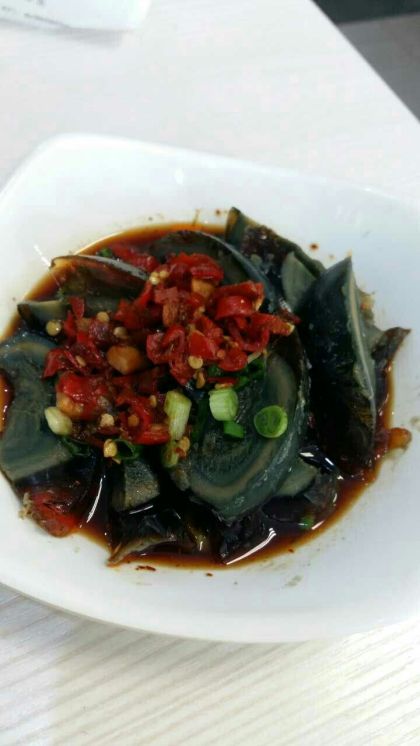
I was more nervous than anything to take my first bite of this aged egg. I felt better when I learned that it is not actually years old but only weeks to months. When I took my first bite (Video linked to my YouTube channel!) I was pleasantly surprised. What I tasted was much more pleasant than I had ever believed it would be. It tastes a lot like a salted duck egg but (Thankfully) not nearly as salty. I also noticed it had a very creamy texture, that is actually very delicious. It sits in a broth with soy sauce and vinegar and is covered in diced red chiles, and sliced green onions. The sauce gives quite a bite to the egg overall. In conclusion, I was very surprised that I didn’t wince at the first bite!
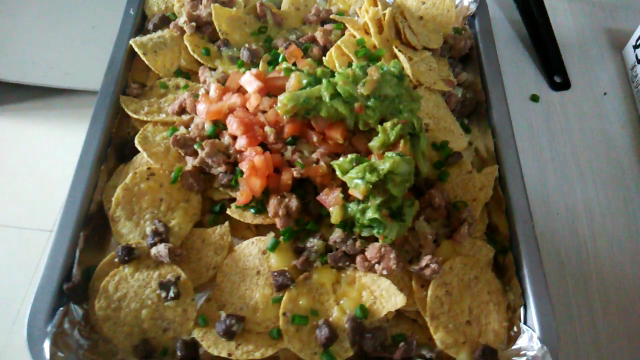
That’s all for today, but I’d also like to leave you with Episode 4 of my cooking show, The Laowai Chef. On episode 4 I made some Mexican food, Steak Nachos with Guacamole. Check it out!
 Ian in China - Living in China content, Asia food and travel videos!